Image
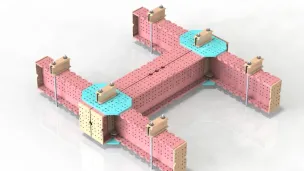

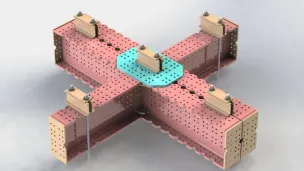
This project was requested by the Engineering Laboratory at the National Institute of Standards and Technology (NIST) to develop Steel Reaction Frames (SRFs). The intended use of the SRFs is to be assembled into test setups, that are post-tensioned to anchoring points for application of vertical and lateral loads in structural testing. They, along with other structures, will form the building blocks of modular structural reaction systems that will permit researchers to study the response of structural systems to demands resulting from disproportionate collapse, earthquakes and other diverse structural loads.
This project was requested by the Engineering Laboratory at the National Institute of Standards and Technology (NIST) to develop Steel Reaction Frames (SRFs). The intended use of the SRFs is to be assembled into test setups, that are post-tensioned to anchoring points for application of vertical and lateral loads in structural testing. They, along with other structures, will form the building blocks of modular structural reaction systems that will permit researchers to study the response of structural systems to demands resulting from disproportionate collapse, earthquakes and other diverse structural loads.
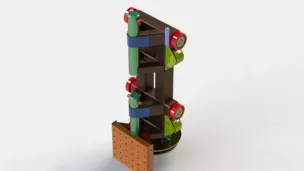
Requisitioned by the US Army Corps of Engineers, the project consisted of developing a model of a Floating Mooring Bitt to be mounted on a 42" HDPE Pontoon and used for mooring vessels at the Markland Locks and Dam in Warsaw, Kentucky.
An example of Large Diameter HVAC fabrication for the Mining Industry. Made from carbon steel plate in sizes in excess of 36" diameter, this project included a number of custom transitions and fittings.
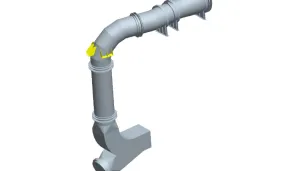
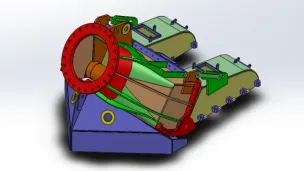
The US Army Corps of Engineers has a mission to maintain navigation on US Federal navigation projects in the United States. Most navigation channels require regular dredging to maintain adequate channel depths. Trailing suction hopper dredges are routinely used to maintain many deep draft channels and, unfortunately, the dredge's dragheads used to remove sediments from the bottom can entrain sea turtles resting in or on the bottom.
This project was initiated to develop a customized draghead that would reduce or eliminate the uptake of sea turtles during dredging operations by gently deflecting them from the path of the dredge.